
Walhalla: Where History Meets the Present
The changing role of small country towns has intrigued me for many years. As a photographer, exploring how they survive, adapt, or disappear has been both an educational journey and an artistic challenge. I was first drawn to the historic gold-mining town of Walhalla as a teenager. Growing up in West Gippsland, Walhalla was little more than an hour from home, although it was never a regular destination for my family. My connection came instead through an old geological survey map of the region, given to me by an uncle who had a passion for history. At the time I was fascinated by rocks and minerals, and long before Walhalla became a tourist destination I came to understand that the town owed its existence to the geology beneath the surrounding mountains.
Today there is a sense of pride in the carefully restored buildings, painted in traditional heritage colours and nestled among densely forested hills. Yet the town’s history tells a very different story, and it was this contrast between past and present that I wanted to capture.
Creation of the Artworks
The idea for the project began during a day trip to Walhalla, a pleasant drive through the beautiful forests in the area. Throughout the town, interpretive signs display historical photographs alongside information about the buildings, streets, and industries that once occupied the valley. Seeing these images in the locations where they were originally taken created an immediate connection between past and present. Rather than reconstructing Walhalla exactly as it once appeared, the project sought to create visual encounters between past and present, allowing traces of history to emerge within the modern landscape.
Not every site, however, was suitable for the type of imagery I wanted to create. Beyond the historical significance, I was also looking for locations that worked as photographs in their own right, with strong composition, interesting light, and enough surviving elements to support a meaningful visual link between the two eras.
Once a shortlist of locations had been selected, the research phase began. I sourced digital copies of historical photographs from the Walhalla Visitor Information Centre and a range of online archives, museums, and historical collections. Armed with these reference images, I returned to Walhalla to photograph each scene from a viewpoint that closely matched the original.
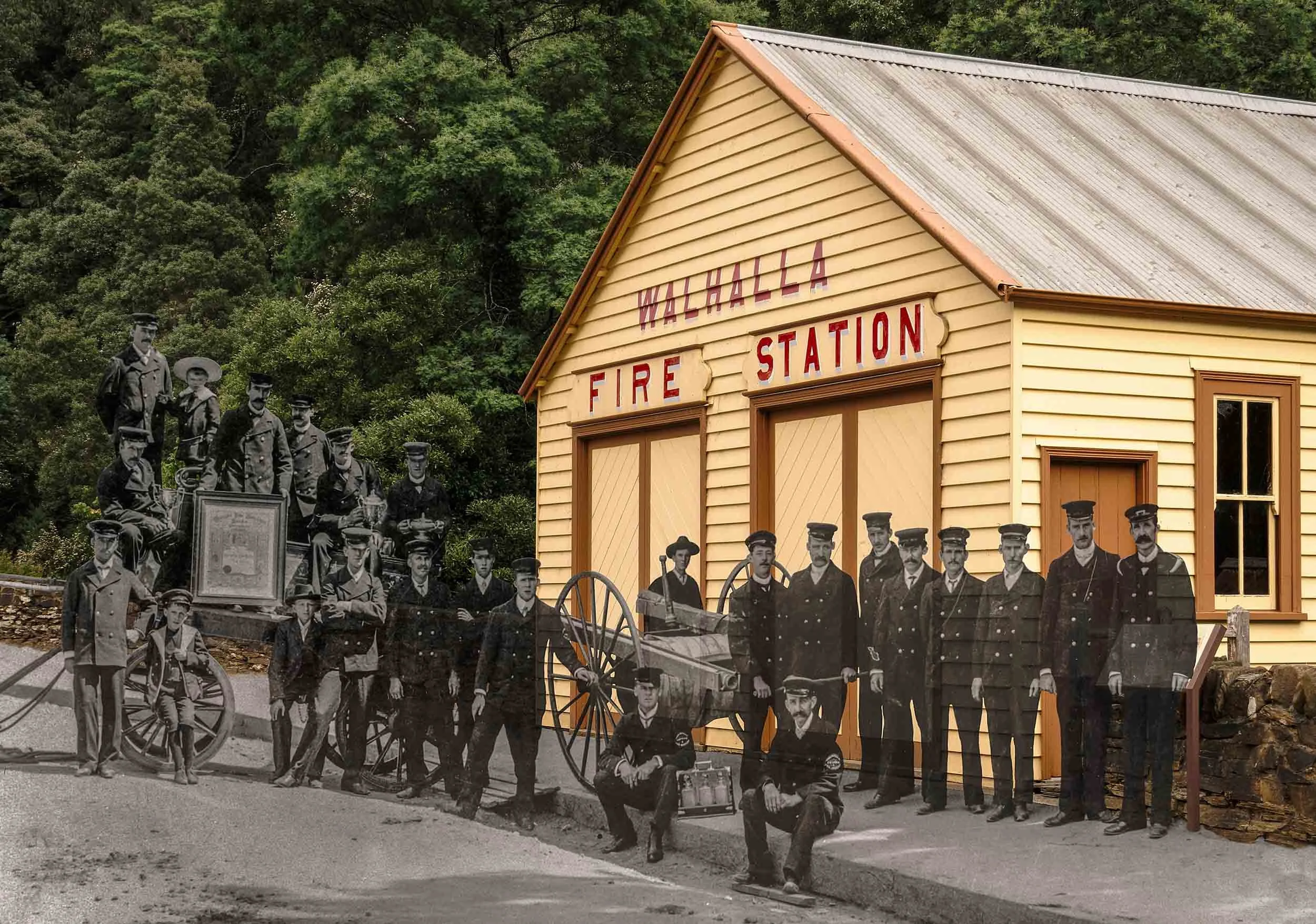
An example of the blended artwork I present at the end of this blog post. Here, the Walhalla Volunteer Fire Brigade (around the start of the 20th century) appear in front of the current Fire Station museum
The archival photographs then underwent extensive manual preparation. Their age, low contrast, and often soft detail made automatic extraction impractical, requiring buildings, machinery, people, and other key elements to be carefully separated from their backgrounds by hand. These historical fragments were then blended into the contemporary photographs using transparency and displacement mapping techniques, allowing them to conform to the surfaces and textures of the modern landscape. Rather than presenting a literal reconstruction, the intention was to create the impression of the past briefly re-emerging within the present-day town.
While undertaking this thematic work I gained a greater appreciation for the beauty and legacy of the township of Walhalla. The ten images which I have the greatest bond with are below, along with their story.
While undertaking this thematic work I gained a greater appreciation for the beauty and legacy of the township of Walhalla. To understand the locations featured in the artworks, it helps to first understand the remarkable rise, decline and renewal of the town itself. The ten images with which I feel the strongest connection, along with their stories, follow this brief history of Walhalla.
For those interested in exploring the collection further, high-resolution digital versions of the ten featured artworks are available as a downloadable bundle. The Walhalla Cemetery image is also offered as a complimentary download to Studio Journal subscribers.
A Brief History of Walhalla
Main Street of Walhalla with the band rotunda to centre left, Walhalla,Victoria, ca. 1905.
Lee Brothers. (1890). Lee collection of photographs of the Walhalla region, Victoria , National Library of Australia nla.obj-152072682
Walhalla began in 1862 when Ned Stringer and his prospecting party discovered gold in what became known as Stringer’s Creek. The discovery transformed a remote valley into one of Victoria’s richest gold-mining settlements. Unlike many gold rush towns, Walhalla’s wealth came largely from quartz reef mining, with mines such as the Long Tunnel and Long Tunnel Extended producing vast quantities of gold.
At its peak the town supported more than 4,000 residents, with businesses, hotels, schools and community buildings crowded into the narrow valley and climbing the surrounding hillsides. Much of the forest was cleared to support mining and daily life.
As the gold industry declined in the early twentieth century, so too did Walhalla. Residents left, buildings disappeared, and the forest gradually reclaimed the landscape. Today the town stands as one of Victoria’s best-preserved goldfields communities, where traces of its remarkable past remain visible throughout the valley.
Walhalla – Then and Now
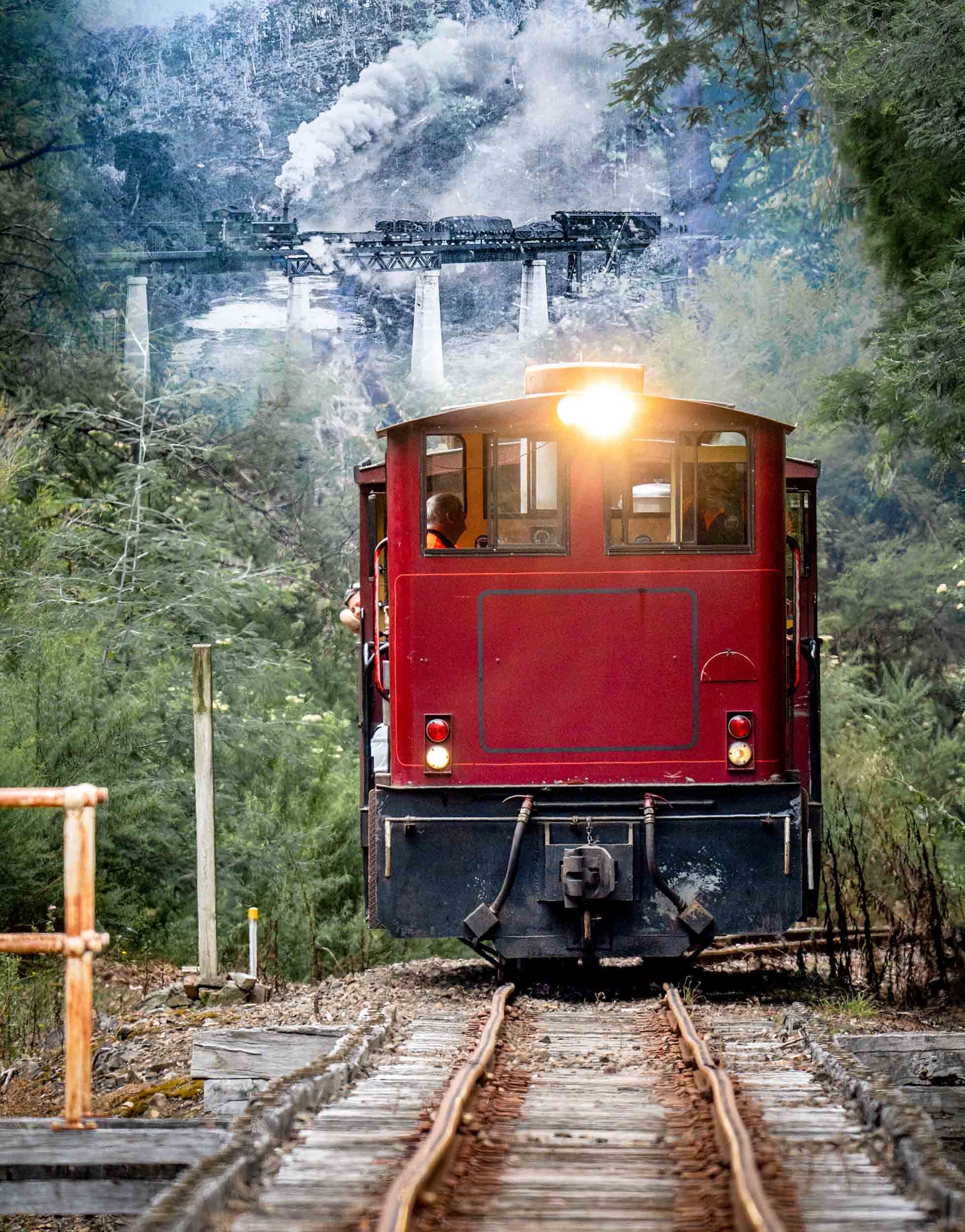
Walhalla Goldfields Railway
Talk of a railway connection from Moe to Walhalla started a decade after gold was discovered, but thirty years passed before work started. It was to be the last of four experimental narrow-gauge lines constructed by the Victorian Railways and when opened was one of the most picturesque train routes in Australia. Unfortunately, just four years after the rail service commenced the two main mines in Walhalla had ceased operation. The rail service to Walhalla subsequently closed in 1944 but continued to operate carrying passengers and freight – primarily timber – between Moe and Erica until 1954. A major effort to restore part of the track as a tourist railway began in 1993. Today, the 4 km of rail from Walhalla to a station at Thomson River Bridge (at the end of the bridge shown in this historical photo) carries many more passengers each year than it did as an operational passenger service.
Historical image: Historical image: Lee Brothers. (1890). Lee collection of photographs of the Walhalla region, Victoria, National Library of Australia, nla.obj-152075591
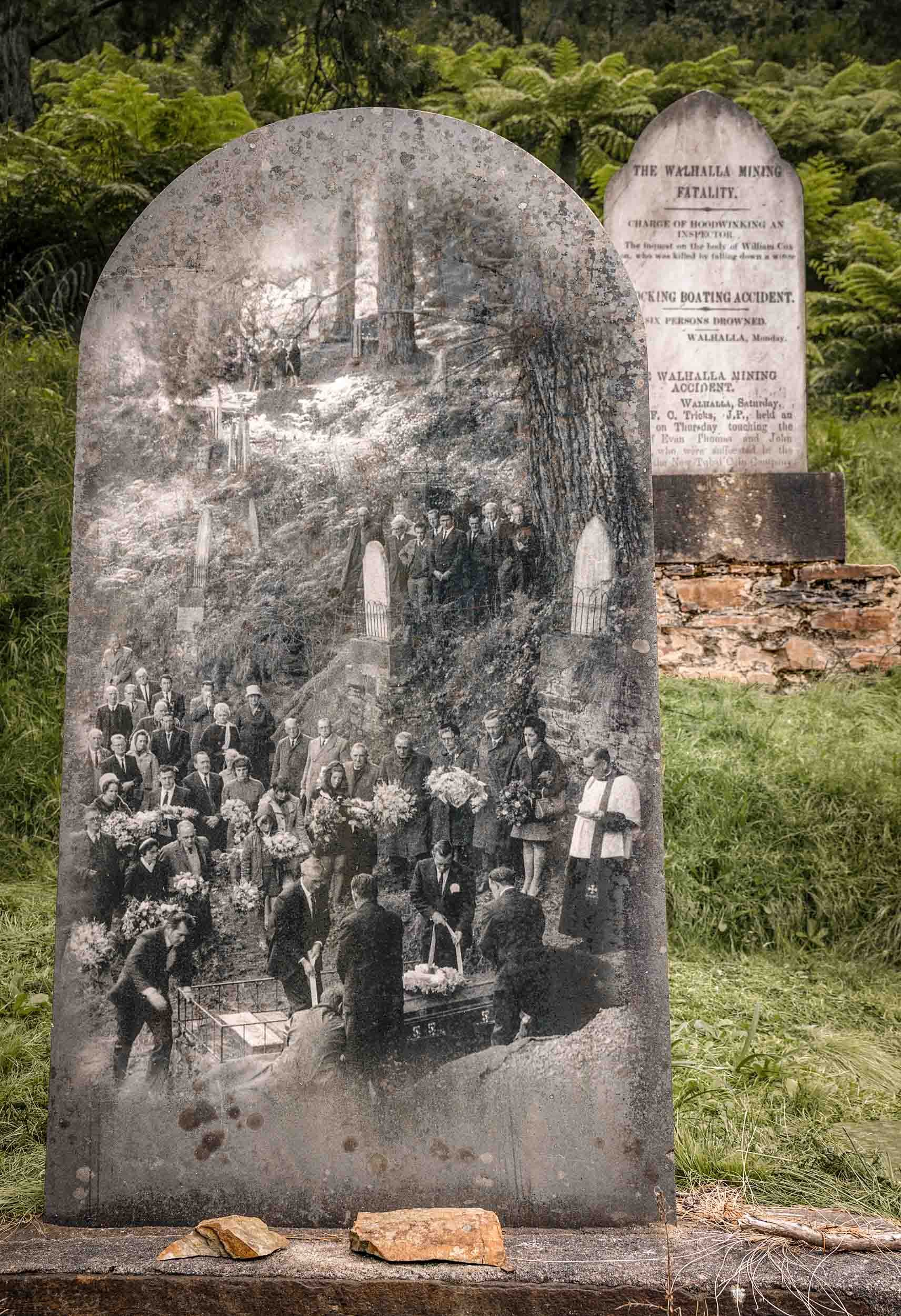
Walhalla Cemetery
Local rumour goes – apparently untrue – that the cemetery in Walhalla is so steep that people are buried standing up. With the narrow valley floor given to activities around gold mining and daily life, the steep slope near the end of town was the best practical option available. The old image superimposed on the tombstone was taken in 1970. It shows the funeral of Dominic Guatta, the last recognised goldminer to be buried in Walhalla. His grave was marked by a cross; one of more than 1300 burials within the cemetery, many of which can no longer be found. The earliest recorded burial occurred in 1866, just four years after the discovery of gold in the creek which passes 25 metres below along the valley floor.
Historical image: Courtesy of Walhalla Museum. Photographer: Bruce Postle/The Age
Historical text: National Library of Australia

Fire Station museum
Volunteers from around Walhalla came together to form a fire brigade in 1871 and established the original fire station in the Long Tunnel Mine yard. The brigade was registered in 1889 following the devastating fire which destroyed some thirty buildings in the heart of town the year before. About a decade later it was decided to provide the brigade with a new fire station centrally located in town. As there was a shortage of suitable land the current site straddling Stringer's Creek was chosen. The included historical image shows the Walhalla Volunteer Fire Brigade at that location shortly after the station became operational. The building has undergone some modifications since and now serves as a museum dedicated to fire fighting in the town.
Historical image: Courtesy of Walhalla Museum
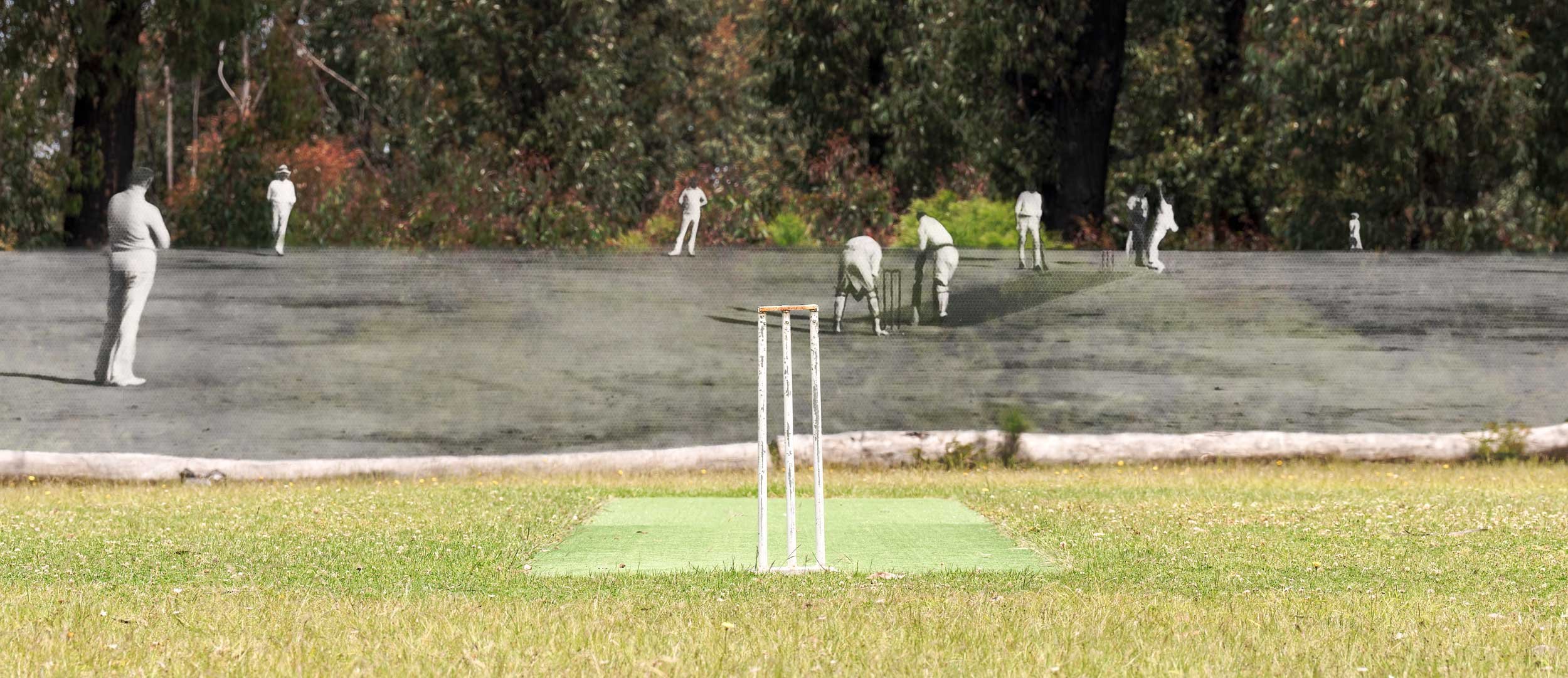
Walhalla Recreation Ground
Sport helps bind a community, and to do so generally needs a place for spectators to gather and players compete. With flat land at a premium the Walhalla locals had to think laterally — or vertically in this case. Beginning in 1882 and with a lot of sweat and toil, people took to pick and shovel and levelled the top of a nearby peak to create what became known as "Recreation Hill". The ground was (and still is) used for a range of recreational and social activities, primarily football and cricket. There was no need for a pre-match warm-up; the steep 200 metre climb from the road took care of that! The ground was restored after a bushfire destroyed the pitch in 2019, enabling the Walhalla Cricket Club to commemorate its 150th anniversary with a game in early 2023.
Historical image: Courtesy of Walhalla Museum
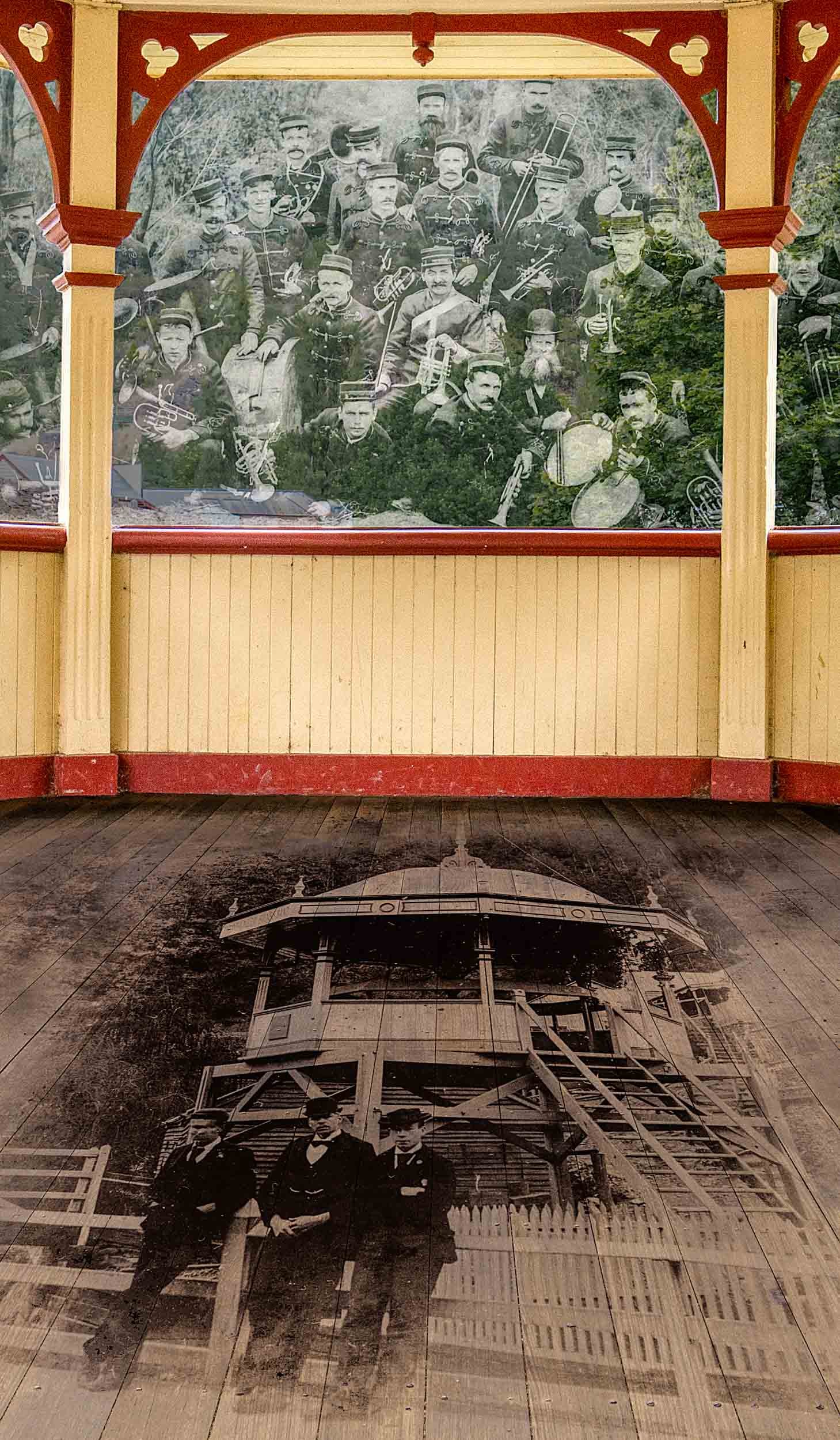
Mountaineer Brass Band Rotunda
Isolated in the mountains and with a township all too familiar with toil and struggle, Walhalla needed a venue for folk to relax and unwind. Thus, the town’s rotunda was built in 1896 and became a centrepoint of entertainment. People would come to hear the Mountaineer Brass Band, which was a regular feature act on a Saturday night when all the shops were open. The frequency and energy of entertainment centred around Walhalla’s rotunda may have waned, but the rotunda remains as a focus of attention for the tourist.
Historical images: Courtesy of Walhalla Museum
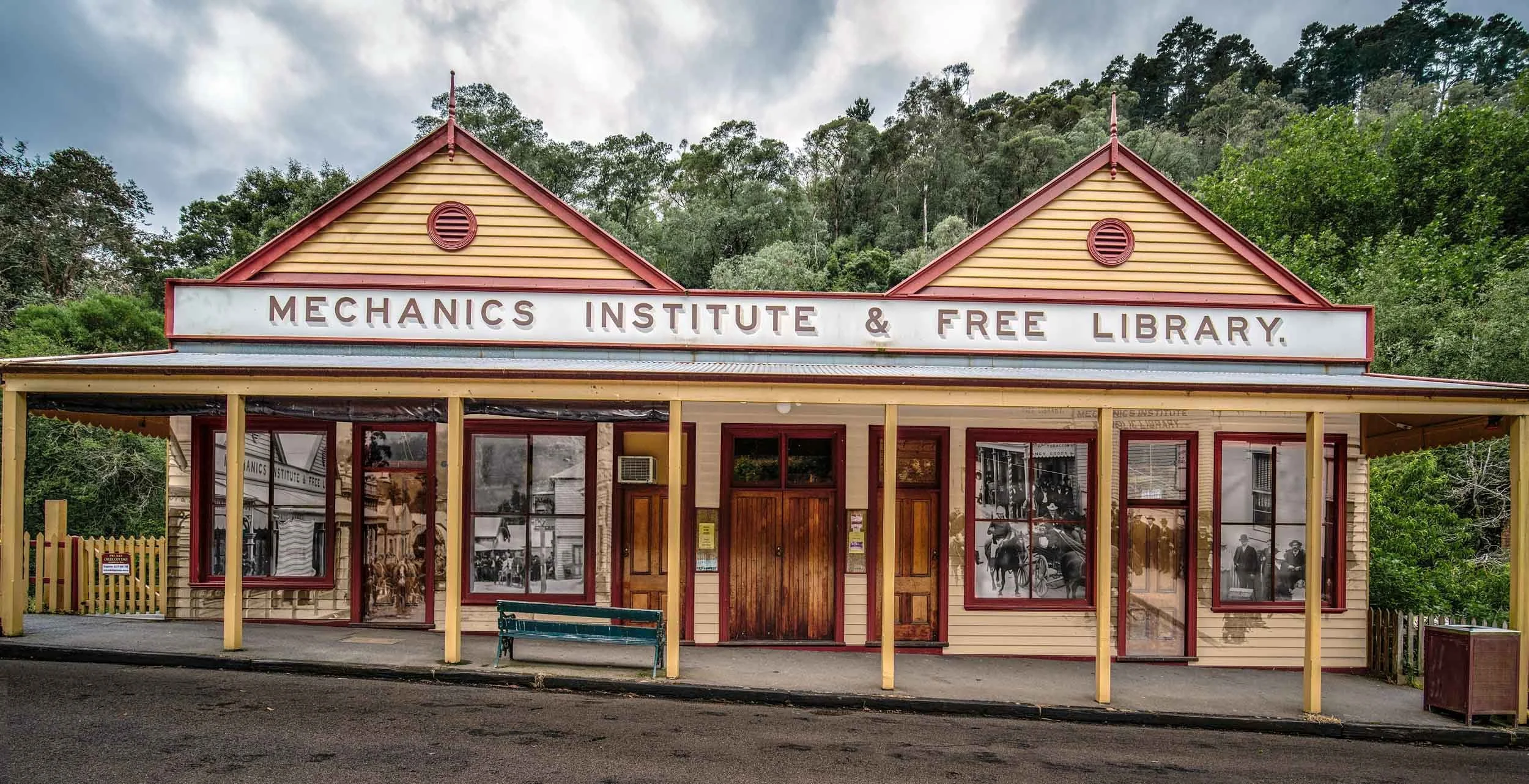
Mechanics Institute and Free Library
Mechanics Institutes started to appear in Britain in the early 1800s and were important to the social dynamic and prosperity of a town. Not only did they provide adult science and technology training and up-skilling for the working class, but many had a library which helped pass the time as an alternative to alcohol and gambling. Many Institutes would also have a social programme. The Mechanics Institute in Walhalla was one of more than 1200 built in Victoria. As the town started to grow it provided a location for schooling and worship until dedicated buildings could be constructed. Like many existing town buildings it is not the original, having been rebuilt twice, most recently in 1980. Both historical images show the Institute after the initial rebuild. The image to the right also shows two mounted police with a shipment of gold outside the Bank of Victoria, which like the Institute building was reconstructed after the 1888 fire. Today, the Walhalla Mechanics Institute building provides facilities for retail and venue hire.
Historical image (left): The Gippsland and Regional Studies Collection (GRSC), Reproduced courtesy Federation University Australia
Historical image (right): Rodda Collection, Museums Victoria, MM 42864
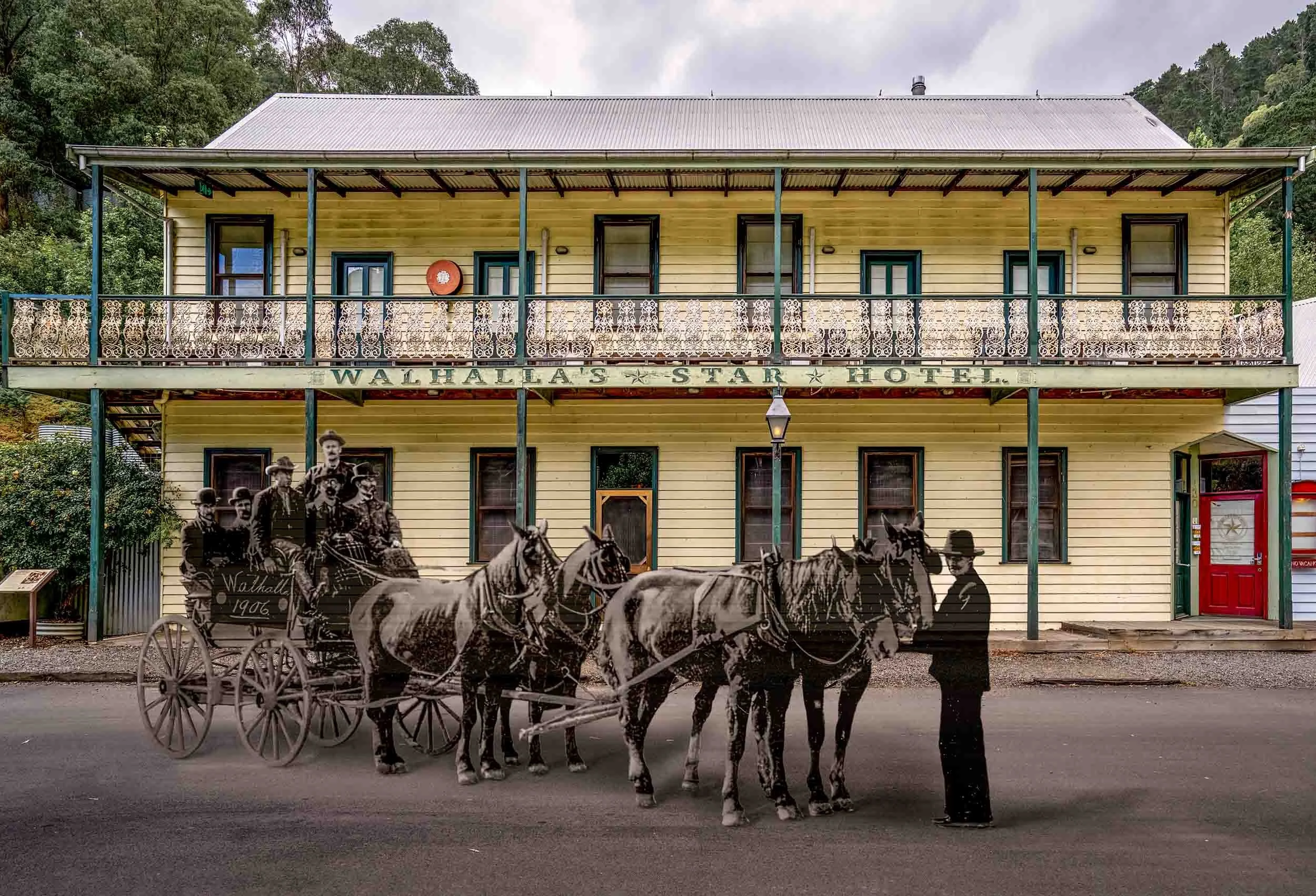
Walhalla’s Star Hotel
The Star Hotel was one of more than a dozen hotels in town at the peak of the gold mining period and a frequent staging point for transport in and out of town. Located opposite the rotunda it was also perhaps an ideal location for a pre-entertainment drink or two. Unfortunately, the Star Hotel, which was the last of Walhalla's original hotels, was destroyed in 1951 by a fire starting in the hot water service. By that time it was a shadow of its former glory. However, in 1998 a new hotel was built, the exterior designed to recreate the facade of its predecessor. Around the same time Walhalla was finally connected to a reticulated electricity supply, and the hotel was its first customer.
Historical image: The Gippsland and Regional Studies Collection (GRSC), Reproduced courtesy Federation University Australia
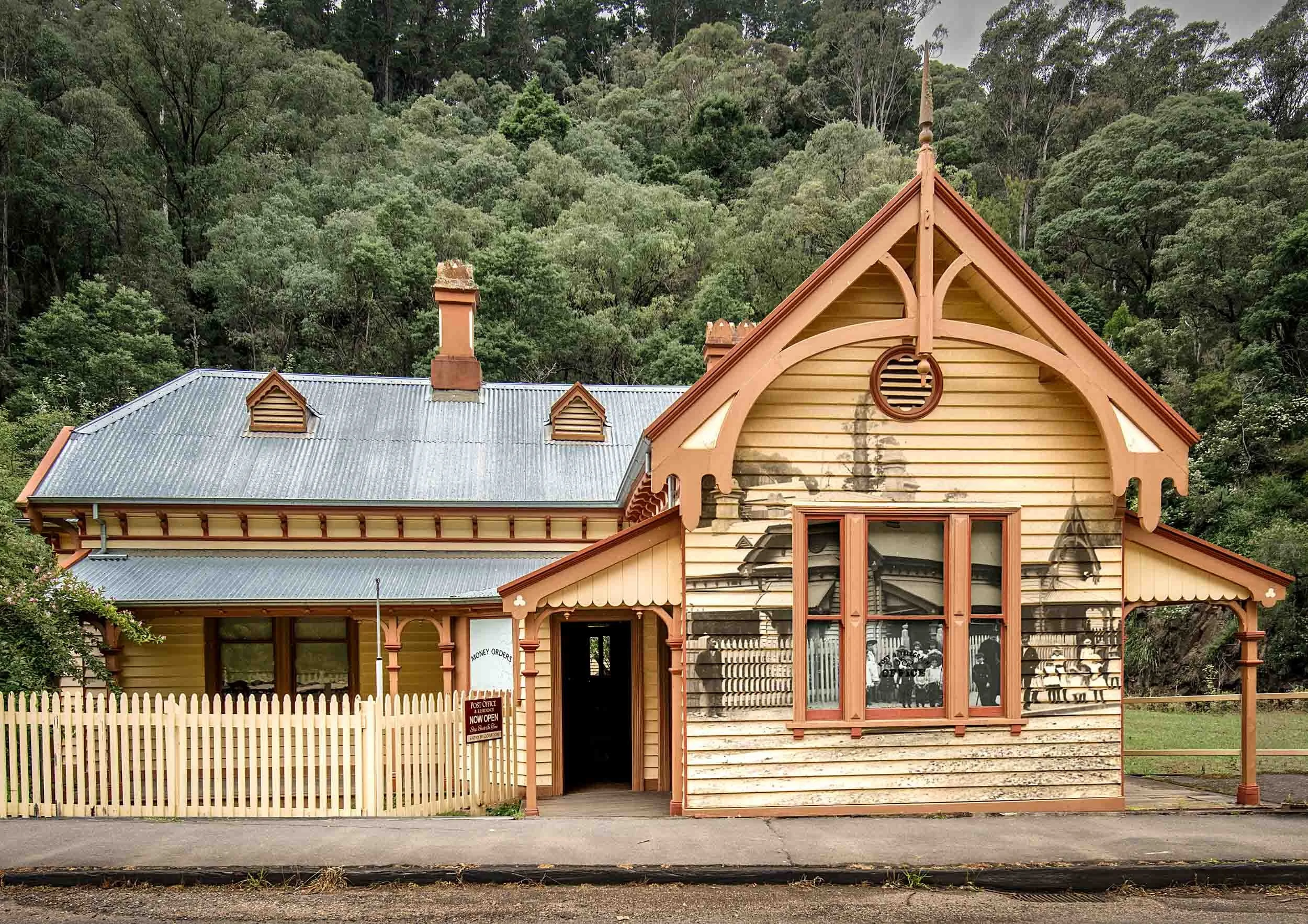
Old Post Office Museum
Imagine the vast quantity of letters and parcels, telegrams, news, money orders and other items which would have moved in and out of a thriving but isolated mining town like Walhalla. More than a century ago this Post Office was the primary avenue of communication, handling around 50,000 items of mail a year. Today, as a museum, it preserves some of those same items for posterity. The heritage listed building comprising the post office and post master’s residence was built in 1886, and by surviving flood and fire it is the only original public building remaining in town.
Historical image: Lee Brothers. (1890). Lee collection of photographs of the Walhalla region, Victoria, National Library of Australia, nla.obj-152074390
Long Tunnel Extended Gold Mine
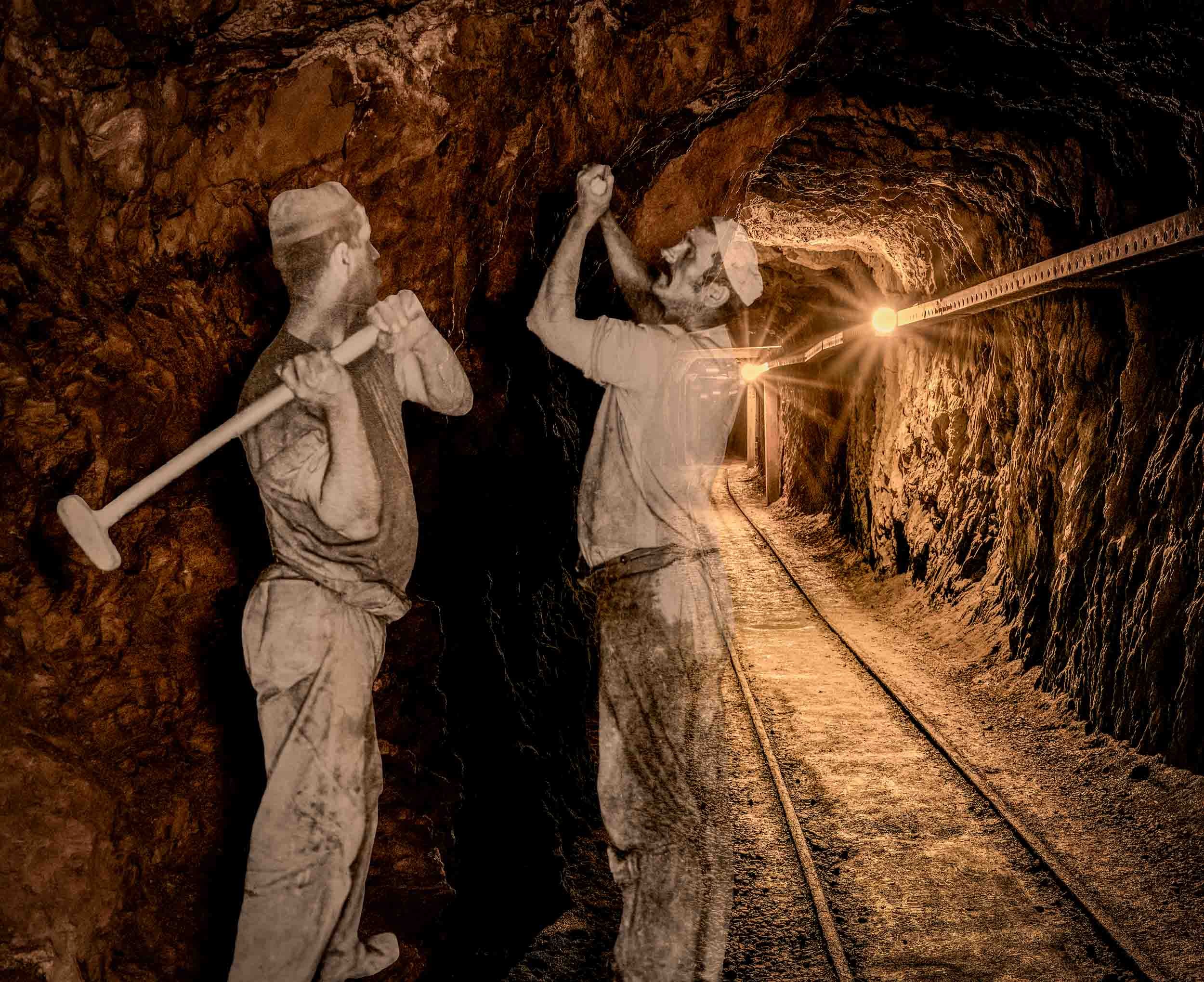
As Ned Stringer found out to his joy, there was gold to be found around Walhalla in alluvial deposits along Stringers Creek. However, most of the gold was taken from mining Cohen’s Reef, the largest single reef of gold in Victoria. The richest mine was the Long Tunnel which produced more than 30 tonnes of gold until it closed in 1914. Next richest was the Long Tunnel Extended Gold Mine which yielded around 13.7 tonnes of gold from its 8.5 km long network of tunnels. This mine closed in 1911, but work commenced in the early 1970s to open a part of the mine for public tours. The early photograph shows two miners preparing a blasting hole in the gold-bearing rock of Cohen’s Reef.
Historical image: Courtesy of Walhalla Museum
The Corner Stores
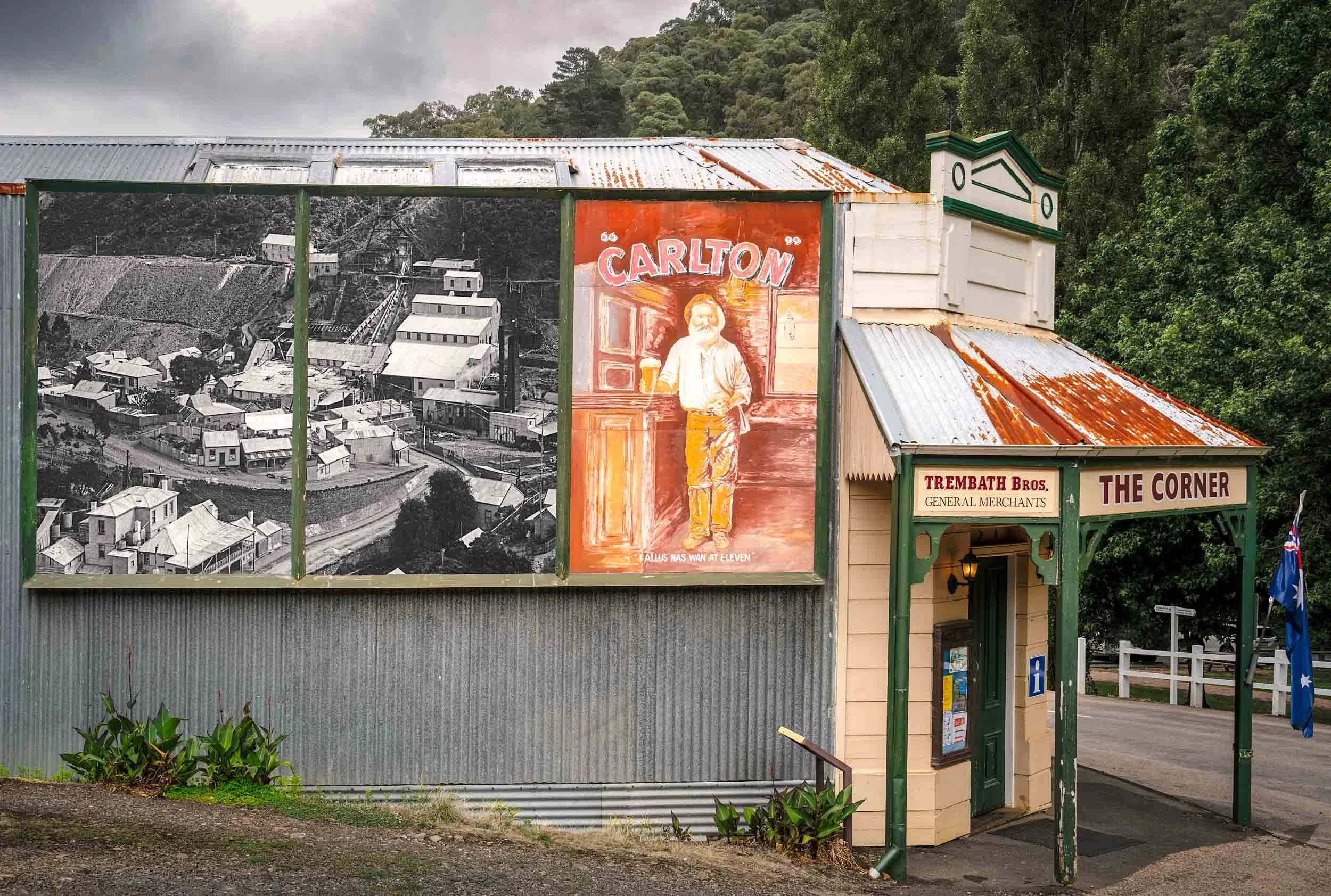
Back in the heyday of gold mining one could look across the road from the Corner Stores to the above-ground operations of the Long Tunnel Mine, as shown in the historical image here. With the nearby thirty-stamp battery house crushing rock continually except for Sundays this was probably not the ideal place for a quiet conversation. But on the plus side, you could at least see at night. This road junction was one of the earliest locations in the world where there was electrified public street lighting, even if only for a short time. The lamps were installed by the Long Tunnel Mining Company apparently to dissuade local residents from stealing scarce firewood from the company stockpile. The building currently operates as a Post Office agency, shop and Tourist Information Centre.
Historical image: Lee Brothers. (1890). Lee collection of photographs of the Walhalla region, Victoria, National Library of Australia, nla.obj-152072682